Why Budget Phone Cameras Just Got Genuinely Good
Analysis · Published 19 July 2026 · Updated 19 July 2026
Written by Rohan Mehta, Mobile Editor
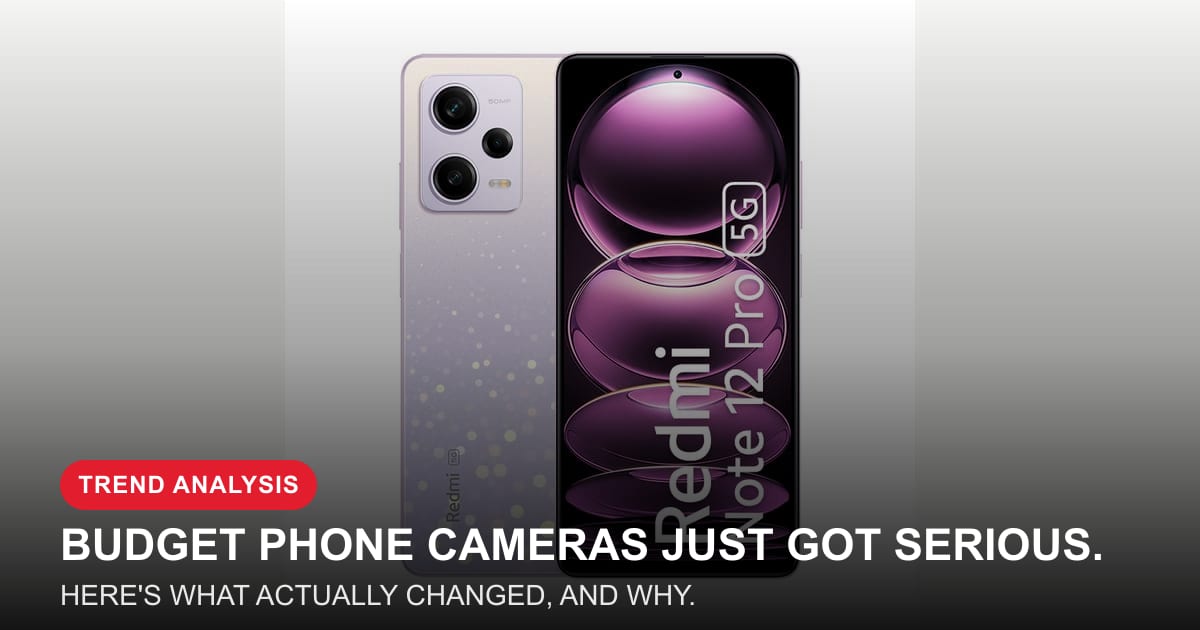
Five years ago, "budget phone camera" was shorthand for grainy low-light shots and washed-out colours. That's no longer a safe assumption. Phones like the Redmi Note 12 Pro 5G and Moto G85 5G now ship with hardware that was flagship-exclusive not long ago. Here's what actually changed.
Quick Answer
Budget phone cameras improved mainly because sensor and OIS component costs dropped as flagship adoption scaled up manufacturing volume, letting chipmakers push computational photography processing down into cheaper mid-range chipsets — so the hardware quality gap narrowed even though the price gap stayed wide.
Component Costs Fell as Flagships Scaled Volume
Optical image stabilisation modules and larger 50MP sensors were expensive specifically because early production volumes were low, restricted to a handful of flagship models. As more manufacturers adopted the same sensor families across their lineups, per-unit component costs fell — and manufacturers competing hard in the crowded mid-range segment had every incentive to pass that cost reduction into better camera hardware rather than pure profit margin.
Computational Photography Moved Down the Chipset Stack
The bigger shift is invisible to a spec sheet: image signal processors capable of real-time HDR blending, noise reduction and portrait-mode depth mapping used to require flagship-tier silicon. Chipmakers like MediaTek and Qualcomm have since built that same processing capability into their mid-range chip families, meaning a budget phone's camera app can now do computational heavy lifting that used to need a much more expensive processor.
Where the Gap Still Exists
This isn't full parity with flagships. Telephoto zoom quality, video stabilisation in motion, and low-light processing speed still favour more expensive phones with dedicated hardware and more processing headroom. The realistic takeaway: for well-lit everyday photos and casual video, the gap has mostly closed; for zoom-heavy or low-light-heavy use cases, flagship phones still meaningfully outperform budget options.
Frequently Asked Questions
Do budget phones now have optical image stabilisation (OIS)?
Yes — OIS, once a flagship-exclusive feature, is now common on 50MP main cameras even in the sub-₹25,000 segment, including phones like the Redmi Note 12 Pro 5G.
Are budget phone cameras as good as flagship cameras now?
Not entirely — flagship phones still lead on telephoto zoom, low-light processing speed and video stabilisation, but the everyday photo quality gap has narrowed significantly.
Which budget phone has the best camera right now?
See our full breakdown in Top 5 Phones of 2026 for a ranked comparison by camera use case.