Why Compact SUVs Are Winning India's Car Market
Analysis · Published 19 July 2026 · Updated 19 July 2026
Written by Arjun Malhotra, Cars Editor
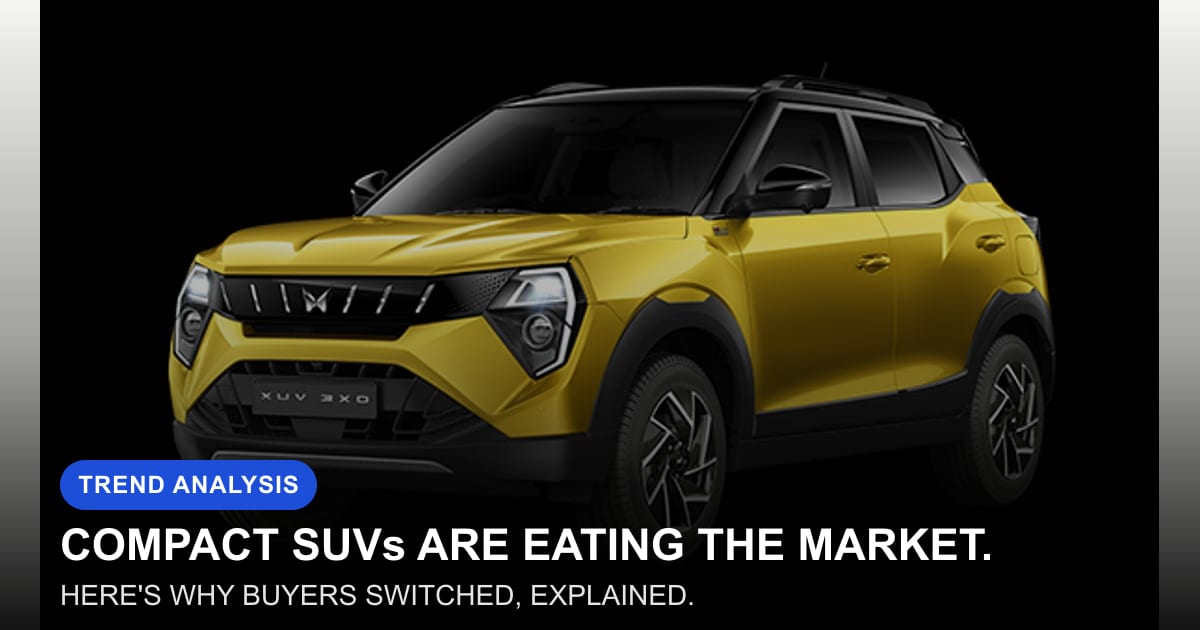
A decade ago, a typical Indian first-time car buyer defaulted to a hatchback almost without thinking about it. That default has quietly flipped. Compact SUVs — sub-4-metre models like the Tata Nexon and Mahindra XUV 3XO — now dominate showroom footfall in a way that would have seemed unlikely when the segment barely existed.
Quick Answer
Compact SUVs overtook hatchbacks in India primarily because of a tax loophole turned genuine engineering trend: sub-4-metre length keeps excise duty lower, so manufacturers packed SUV styling, higher ground clearance and better safety ratings into a hatchback-adjacent price bracket — giving buyers SUV road presence without a proportional price jump.
It Started as a Tax Workaround
The compact SUV boom didn't start as a design revolution — it started as smart engineering around India's excise duty structure, which historically taxed cars under 4 metres in length at a lower rate regardless of body style. Manufacturers realised they could build a genuinely SUV-styled vehicle within that length limit and undercut both traditional hatchbacks on road presence and full-size SUVs on price.
What began as a pricing strategy became a self-reinforcing trend once buyers actually experienced the higher seating position and road visibility — features that are hard to give up once you're used to them, regardless of the original tax logic behind the segment's existence.
Safety Ratings Became a Genuine Selling Point
Global NCAP crash-test publicity over the past several years has made 5-star safety ratings a marketing headline rather than fine print, and compact SUVs — with their reinforced structures built for higher ride heights — have generally scored better than equivalent hatchbacks from the same manufacturers. The Tata Nexon's repeated 5-star ratings are a direct example of this dynamic playing out in real sales numbers.
What This Means for Buyers Right Now
If you're cross-shopping a hatchback against a compact SUV today, the price gap has narrowed enough that the decision usually comes down to genuine preference rather than a hard budget constraint — ground clearance and road presence versus slightly better fuel efficiency and a lower base price. Neither choice is objectively wrong; it depends on what you'll actually use the car for.
Frequently Asked Questions
Why are compact SUVs more expensive than hatchbacks with similar engines?
Higher ground clearance, larger body panels, more sound insulation and typically richer safety-feature lists all add cost even when the underlying engine is shared with a hatchback.
Are compact SUVs less fuel-efficient than hatchbacks?
Generally yes, by a modest margin, due to greater weight and less aerodynamic shape — though the segment has narrowed this gap significantly with modern turbo-petrol and CNG options.
Which compact SUV should a first-time buyer consider?
It depends on priorities — see our full comparison in Top 5 Cars to Buy in July 2026 for a breakdown by use case.