Why Electric Scooters Still Aren't Selling the Way India Was Promised
Deep Dive · Published 22 July 2026 · Updated 22 July 2026
Written by Vivaan Kapoor, Bikes Editor
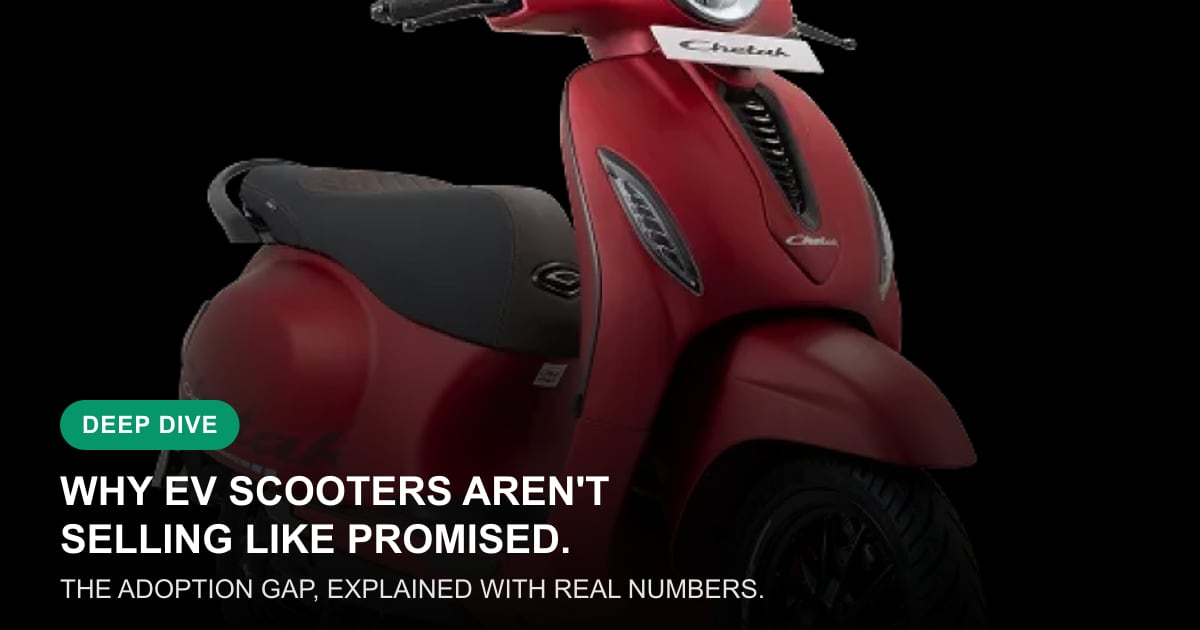
A few years ago, the pitch was simple: electric scooters would be cheaper to run, better for the environment, and would take over Indian roads within a decade. Every major two-wheeler brand — Bajaj with the Chetak, TVS with the iQube, along with newer EV-only players — placed serious bets on that future. The bikes arrived. The mass takeover didn't, at least not on the promised timeline. Here's the honest, unglamorous explanation for the gap between the pitch and reality.
Quick Answer
Electric scooter adoption in India slowed mainly because of three compounding factors: a wave of high-profile battery fire incidents in 2022 that damaged public trust, reduced government subsidy support that erased much of the EV price advantage, and a persistent charging-infrastructure gap that makes ownership genuinely inconvenient for anyone without dedicated home charging access.
The Trust Problem Nobody Fully Recovered From
In 2022, a cluster of battery fire incidents across several electric scooter models made national news — not because EV fires are inherently more common than other vehicle fires, but because they happened in a category still trying to prove itself to a cautious buyer base. Trust, once damaged in a purchase decision this significant, doesn't rebound on the same timeline as a product recall. Manufacturers tightened battery pack design, thermal management systems and testing protocols afterward, but the search-engine memory of those headlines has proven more durable than the actual current safety record.
The Subsidy Math Changed Under Buyers' Feet
Government subsidy support under schemes like FAME played a significant role in making early electric scooters price-competitive with petrol equivalents — in some cases, nearly matching purchase price while promising dramatically lower running costs. When subsidy support was scaled back, that price parity disappeared, pushing effective EV prices meaningfully above petrol scooters again. For a large share of Indian two-wheeler buyers, upfront price still outweighs long-term running-cost savings in the actual purchase decision, regardless of how the total-cost-of-ownership math works out over several years.
Charging Is a Home-Ownership Problem, Not Just an Infrastructure One
The public charging network conversation often misses the actual pattern of two-wheeler charging in India: most EV scooter owners charge overnight at home, not at public stations. That works well for buyers with dedicated parking and easy access to a power socket — and works poorly for the large population of urban renters, apartment-dwellers without assigned parking, and buyers in smaller towns where home charging isn't a given. This is less a "not enough charging stations" problem and more a "not everyone has a good place to charge" problem, and it's a much harder one to solve with public infrastructure investment alone.
Resale Value Uncertainty Is the Quiet Deal-Breaker
Petrol scooters have decades of established resale value patterns that buyers intuitively understand. Electric scooters don't yet have that track record — battery degradation over years of use is a real technical concern, and used-EV buyers have far less certainty about what a 4-year-old electric scooter's battery health, remaining range and resale price should actually look like. That uncertainty gets priced into buyer hesitation even when it isn't explicitly stated as a reason for choosing petrol.
Where This Actually Goes From Here
None of this means electric scooters are a dead-end category — the underlying running-cost economics remain genuinely favourable for the right buyer profile: someone with reliable home charging access, a daily commute well within the scooter's real-world range, and a longer ownership horizon to recoup the higher upfront cost. The realistic path forward looks incremental rather than explosive: battery technology and safety standards maturing further, resale markets slowly building a track record, and adoption concentrating first among buyers whose living situation already solves the charging problem for them.
Frequently Asked Questions
Are electric scooters cheaper to run than petrol scooters in India?
Per-kilometre running cost is generally significantly lower for electric scooters, since electricity costs far less than petrol for equivalent distance — the ownership math usually favours EVs once you factor in daily usage over a few years.
Why did some electric scooters catch fire in India?
A wave of battery fire incidents in 2022, linked to battery pack design and thermal management issues in a handful of models, damaged public trust in the category — manufacturers have since tightened battery testing standards, but the reputational impact lingered.
Is charging infrastructure a real problem for EV scooter buyers?
Yes, particularly for buyers without dedicated home or society parking with charging access — public charging networks remain thin outside major metro areas, making home charging availability the deciding factor for most buyers.
Did government subsidies for electric scooters change?
Yes, subsidy support under India's FAME scheme was reduced from its earlier levels, which raised effective purchase prices and slowed the price advantage EVs had briefly held over petrol scooters.