Why CNG Bikes Are Suddenly Trending in India
Analysis · Published 19 July 2026 · Updated 19 July 2026
Written by Vivaan Kapoor, Bikes Editor
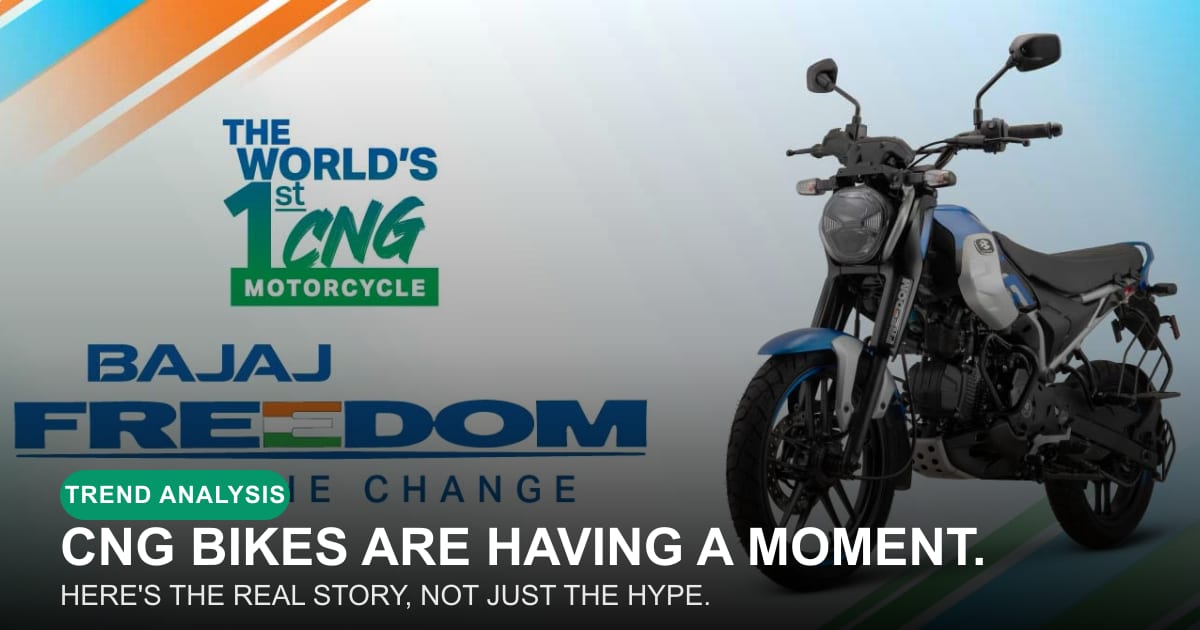
A year ago, "CNG motorcycle" would have sounded like a contradiction to most Indian bike buyers — CNG was a car and auto-rickshaw thing, full stop. That's changed fast. Search interest, showroom footfall questions, and now an actual factory-built product on sale have turned this from a fringe idea into a real conversation. Here's what's actually driving it, separated from the noise.
The Trigger: A Real Product, Not Just a Rumour
Trend pieces about "the future of X" are usually speculative. This one isn't, because Bajaj actually shipped a CNG motorcycle built from the ground up — the Freedom 125 — rather than a retrofit kit or a concept bike shown once at an auto expo and never mentioned again. That distinction matters enormously for how seriously buyers take the category. A concept generates curiosity; a bike sitting in a dealership showroom generates actual cross-shopping conversations.
Once one major manufacturer commits to a segment at scale, the calculus changes for everyone else watching from the sidelines — rivals, component suppliers, and fuel-station operators all start planning around the assumption that this isn't a one-off experiment.
The Real Driver: Fuel Cost, Not Novelty
Strip away the "world's first" headline framing and the actual driver is unglamorous arithmetic. CNG has consistently cost meaningfully less per unit of energy than petrol in most Indian cities for years — that's precisely why autos and taxis switched over at scale long before any motorcycle did. Two-wheeler riders, especially high-mileage commuters and delivery riders who clock serious daily distance, do the exact same cost-per-kilometre math car owners have been doing for over a decade.
What kept motorcycles out of that shift for so long wasn't economics — it was packaging. Fitting a CNG tank safely into a motorcycle frame, without wrecking the bike's handling balance or safety margins, is a harder engineering problem than doing it in a car with far more available chassis space. The current wave of interest reflects that engineering problem finally being solved at a production level, not a sudden change in fuel-cost logic that was always there.
The Real Constraint: Infrastructure, Not Appetite
The honest limiting factor right now isn't buyer interest — it's CNG filling-station density, which remains heavily concentrated in specific cities and highway corridors rather than being uniformly available nationwide. That's exactly why dual-fuel design (a small petrol reserve tank alongside the CNG tank) has been the practical answer so far, rather than a CNG-only motorcycle. Expect adoption to track infrastructure rollout city by city rather than happening as a single nationwide shift.
What This Means If You're Actually Shopping
If your daily riding distance is high and your city has decent CNG station coverage, the economics genuinely favour a CNG or dual-fuel motorcycle over a straightforward mileage comparison — the math compounds fast over a year of daily commuting. If you ride occasionally, or your city has sparse CNG infrastructure, a conventional petrol commuter still makes more practical sense today, regardless of the running-cost appeal on paper.
Frequently Asked Questions
Is the Bajaj Freedom 125 the only CNG motorcycle available in India?
As the first mass-production factory-fitted CNG motorcycle, it's currently the clearest example on the market — we'll update this piece if other manufacturers launch competing models.
Will more manufacturers launch CNG bikes?
No other manufacturer has officially confirmed a competing CNG motorcycle yet — this is an area worth watching rather than something we can confirm today.
Is a CNG bike worth it if I don't ride daily?
Probably not — the higher upfront cost is recovered through fuel savings over distance, so occasional riders are less likely to see a meaningful payback within a typical ownership period.